Most partnership programs make you choose too much, too soon with major commitments, technical complexity, yet unclear ROI.
So, if you’ve ever looked at a partnership opportunity and thought, “I’m not sure which model is right for us yet”, you’re not alone.
Many prospective partners come to doola with a mix of excitement and uncertainty: unsure of how much to commit, how technical the integration needs to be, or whether they have the volume to qualify.
At doola, we’ve designed our partner programs differently:
- You don’t need to have everything figured out.
- You don’t need a massive volume just to begin.
- You don’t need engineering resources right away.
You just need a starting point and doola partner programs are designed to meet you where you are.
Whether you’re a content creator with a loyal audience, a SaaS platform looking to embed business formation into your product, or a high-volume marketplace ready for full API infrastructure, there’s a path for you. And it doesn’t have to start out complicated.
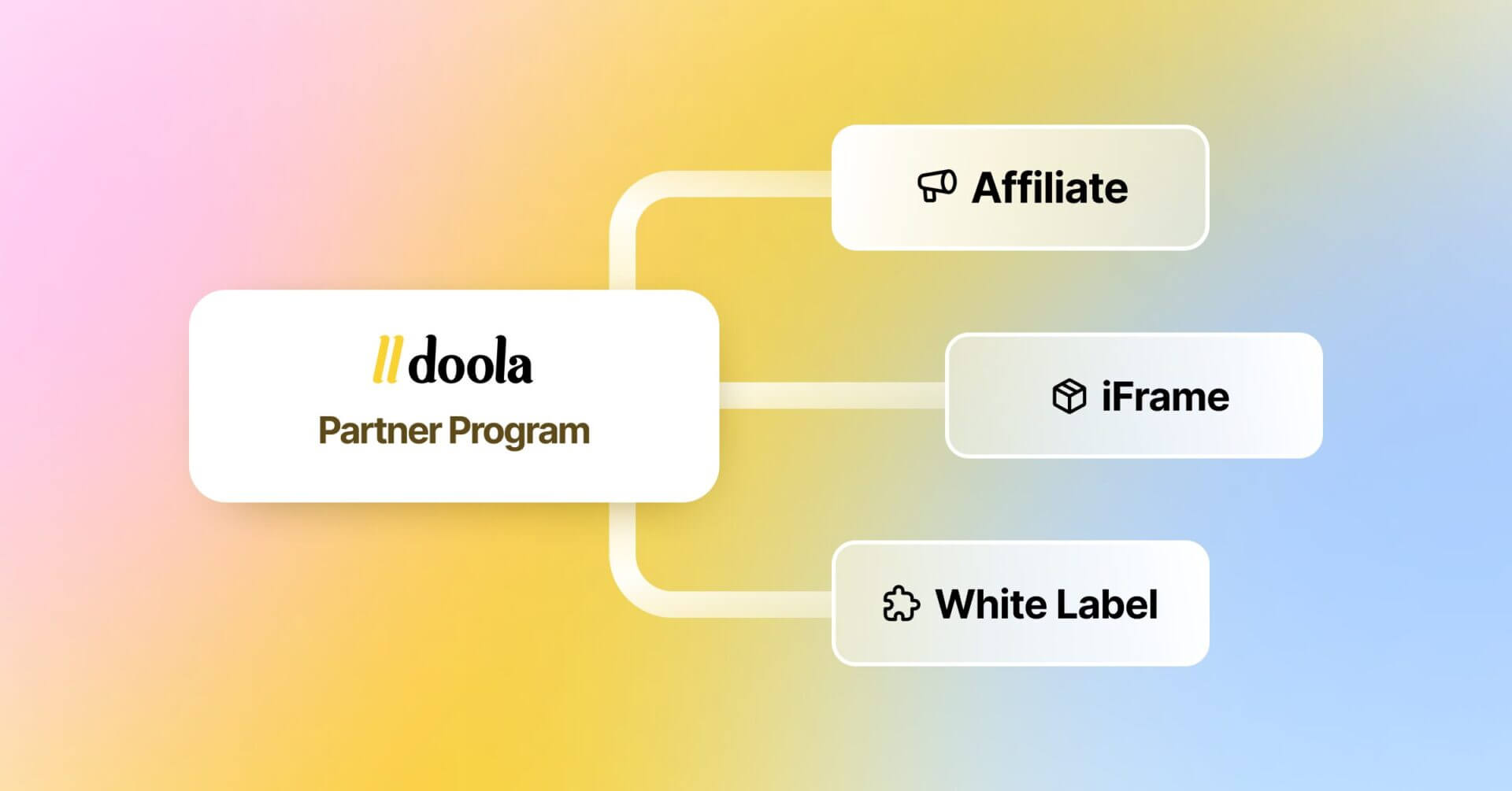
This guide breaks down doola’s three partnership models: Affiliate, iFrame and White Label, and helps you identify which one fits your stage, your goals, and your capacity at this very point.
Apply to become a doola affiliate partner today, and start earning from your very first referral.
How doola Partnerships Work: Crawl → Walk → Run
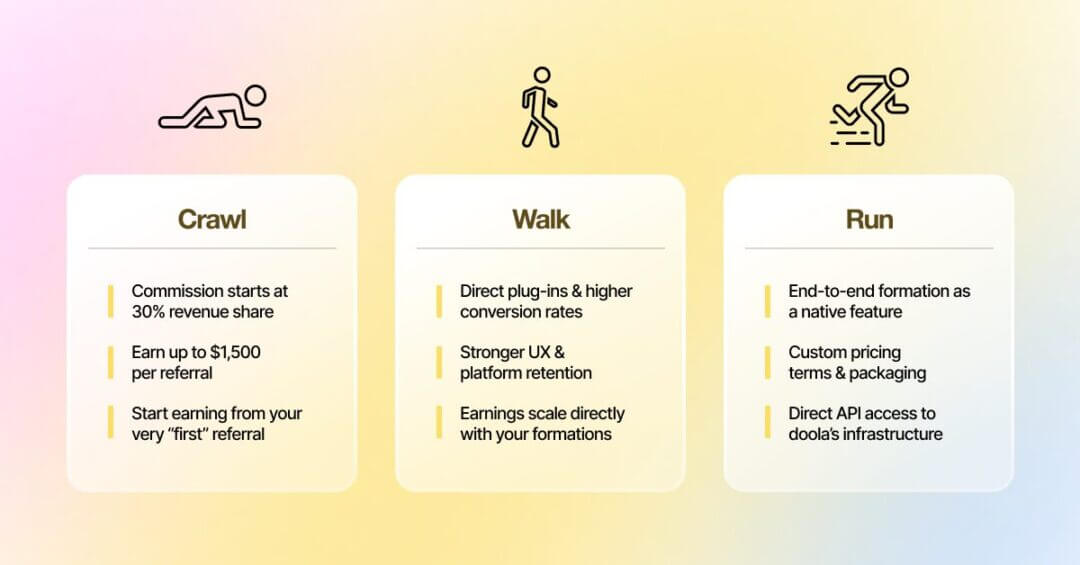
doola structures its partnership program around a simple progression: start lean, prove value, scale deeper.
We call it Crawl → Walk → Run.
Each phase represents a different level of integration, commitment, and upside. Partners don’t need to enter at a specific stage. Where you start depends on your audience, product, and volume.
“We don’t force partners into a starting point. Your entry depends on your audience, product, and volume.”
– Arjun Mahadevan, CEO, doola
Many partners begin at the Affiliate level to validate demand. Others come in directly at iFrame because they already have an active user base. A few jump straight to White Label because they’re building at scale. All paths are valid, and all can evolve over time.
1. Crawl: Affiliate Partner Program | Referral VIP Program
The Affiliate program is the fastest and lowest-effort way to start earning with doola. You share a unique referral link, and when someone in your audience signs up through it, you earn a commission. That’s it, simple.
You don’t need any technical setup, product changes, or operational overhead. You’ll just have a clean, trackable referral flow that monetizes the trust you’ve already built with your audience.
Who It’s Best For
If you already have an audience that looks to you for guidance, this is the most natural way to start monetizing that influence:
- YouTubers, podcasters, and content creators covering entrepreneurship, finance and immigration
- Newsletter writers and educators with engaged subscriber bases
- Community managers and online group administrators
- Consultants and advisors who regularly refer clients to formation services
- Anyone looking to monetize an existing audience with minimal integration
| Key Details for Partners ✔️ Commission starts at 30% revenue share, with tiered upside based on volume ✔️ Earn up to $1,500 per referral depending on the plan your audience chooses ✔️ No minimum volume requirement, start earning from your very “first” referral |
What Will The Partners Get?
As a partner, you’ll get everything you need to start driving and converting traffic, without building anything from scratch:
- A unique referral tracking link built for accurate attribution
- A co-branded landing page tailored to your audience
- Custom promo codes to power campaigns and exclusive offers
- Full access to doola’s Partner Success Kit, packed with ready-to-use creative and copy resources
And once you start seeing traction, you can seamlessly scale into deeper, more integrated partnership models.
Why Should You Start Here?
The Affiliate model is purpose-built for partners who want to test the waters. It validates whether your audience converts, and gives both you and doola the signal needed to explore deeper collaboration.
Most of our partners who later scaled into iFrame or White Label started here first.
2. Walk: Embedded iFrame Experience
Instead of sending users off-platform, you embed doola’s full signup and onboarding flow right inside your interface, so users can start and complete their business formation without ever leaving your ecosystem.
The iFrame model brings doola directly into your product experience.
It’s a seamless, embedded doola experience that feels native to your platform, with doola handling the entire infrastructure in the background, from formation to filing and compliance.
How It Works
doola provides an embed code that you plug directly into your platform. When users are ready to form their business, they go through doola’s onboarding flow without leaving your interface.
From the user’s perspective, it feels like a core feature of your product. From your side, it’s a lightweight integration that requires no “complex” infrastructure or heavy engineering resources.
Who It’s Best For
If you’re building a product or ecosystem where users are actively starting businesses, this model helps you meet them exactly where they are:
- SaaS platforms and marketplaces serving entrepreneurs or small business owners
- Banking or fintech apps looking to offer business formation as a native feature
- Online communities or course platforms where members are launching ventures
- Partners generating ~50+ formations per month (or actively scaling toward it)
This model is ideal for partners who already see traction and want to own more of the user journey without overbuilding.
What Are The Key Benefits?
Beyond the seamless user experience, the iFrame model delivers meaningful business advantages for your platform:
- Higher conversion rates: Users will stay within your product instead of being redirected.
- Stronger UX and platform retention: Formation becomes a part of your “core offering”.
- Minimal operational burden: doola will handle the formation, compliance, and support.
- Revenue share upside: Your earnings will scale directly with the “formations” you drive.
All of this adds up to a more cohesive product experience and a more scalable revenue stream.
Why This Model Works
The iFrame model offers the best balance between integration depth and speed to market. You get significantly more ownership over the user experience than the Affiliate model provides, without the complexity, cost, or timelines of a full API integration.
The iFrame model hits the optimal spot between speed and sophistication.
It’s the natural next step for partners who have proven demand and want to create a more seamless, embedded product experience.
3. Run: White Label | API Integration
The White Label model gives partners direct API access to doola’s business formation infrastructure. This isn’t simply embedding a flow; rather, it’s plugging doola’s capabilities directly into your backend while presenting a completely branded, fully native experience to your users.
At this level, doola becomes an invisible layer in your product stack. Your users interact with your brand, your UX, and your experience. doola efficiently runs the engine at scale underneath.
What’s Included
This model gives you access to doola’s core formation infrastructure as a fully configurable, API-driven backend:
- Business entity formation: LLC, Corporations, and other US business entities
- Registered agent services: Ongoing compliance coverage handled end-to-end
- EIN procurement: Employer Identification Number filing managed for your users
- Core Starter plan components: The foundational suite you need to get up and running
- Custom pricing and packaging: Terms negotiated directly with doola’s partnerships team based on your volume and use case
Together, these capabilities enable you to offer end-to-end business formation as a native feature, without building the operational or compliance layer from scratch.
Who It’s Best For
The White Label model is built for operators who are past the proof-of-concept stage and ready to make business formation a core, scalable part of their product:
- High-volume platforms processing 100 or more formations every month
- SaaS companies wanting full control over UX and complete user journeys
- Fintech, banking, or infrastructure players embedding business services natively
- Operators with proven demand who need a scalable, white-glove backend solution
If you’re at the stage where formation volume is a meaningful part of your business, or where it needs to be, this is the model designed for you.
Commercial Structure
There’s no off-the-shelf package here.
White Label pricing is custom, structured around your volume, use case, and integration scope.
Partners work directly with doola’s partnerships team to define terms. This model will be useful once there’s proven scale and a clear operational need.
Why This Is the End Game for doola Partners
Most partners don’t typically start with this, but many aspire to, and the best ones build toward it.
In essence, the White Label model is for partners who have proven traction and are ready to integrate doola into the very foundation of their product experience
You get a fully owned, scalable business formation capability, without having to build the compliance and operational infrastructure from scratch.
Affiliate vs iFrame vs White Label: Key Differences
If you’re still on the fence about which model fits your business needs, here’s a quick reference:
| Feature | Affiliate | iFrame | White Label |
| Setup effort | Minimal, share a link | Low, embed a snippet | Medium, API integration |
| Tech required | None | Basic (embed code) | Developer resources |
| UX control | Low | Medium | Full |
| Best for | Creators, educators, communities | Platforms & marketplaces | High-volume SaaS / infra partners |
| Volume expectation | Any | ~50+ formations/month | 100+ formations / month |
How doola Supports Partners and Their Customers
Regardless of which model you choose, doola manages the entire operational stack for your customers, through all stages of their business lifecycle, from formation to long-term compliance:
- Business formation (LLCs, Corps, and other entity types across all 50 US states)
- Registered agent services for ongoing compliance so users never miss deadlines
- EIN and ITIN procurement to ensure your tax identification is handled end-to-end
- Annual report filings and state compliance requirements, as per IRS regulations
- Bookkeeping and financial recordkeeping to maintain clean records year-round
- Tax filing & preparation by experienced professionals to reduce stress at tax time
- Business banking setup to get all your customers financially up and running, fast
- Ongoing customer support and dedicated assistance throughout business lifecycle
In the aggregate, you’re not just plugging into a feature, you’re plugging into a full-stack business operations engine.
Why This Matters for Partners
When you refer or embed doola, you’re not just giving your audience access to a formation tool; you’re connecting them to a full-service business operations platform built for long-term success
This has two critical benefits for you as a partner:
1. Reduced support burden: doola entirely handles customer questions, compliance issues, and operational complexities & edge cases. Your team stays focused on what you actually built.
2. Higher customer success rates: Users who are well-supported stick around longer, convert at higher rates, and generate more referral value over time. Our success is directly tied to yours.
You don’t need to become an expert in business formation, tax law, or compliance. doola’s team and infrastructure handle that, allowing you to focus on your core offering with confidence that your users are fully supported.
How to Choose the Right Partnership Model
If you’re still deciding which of the three doola partner programs is best for you, use these scenarios as a guide:
Just starting out or want to test demand?
Start with Affiliate. It requires no technical investment and zero operational commitment. If your audience converts, you’ll know quickly, and you’ll have the complete data to justify going deeper.
Already have a product and want a seamless user experience?
Move to iFrame. If you’re a platform with regular user activity and you want formation to feel like a native feature and not a redirect, the iFrame is the right fit. The embedded experience gives you better UX, higher conversions, and stronger product stickiness.
Operating at scale and want full control?
Explore White Label. If you’re processing significant volume and need a fully branded, fully customizable solution, the API model gives you complete ownership without building the infrastructure yourself.
“Most partners start simple and scale as volume grows. There’s no penalty for starting at Affiliate — and no ceiling on where the partnership can go.”
– Arjun Mahadevan, CEO, doola
How to Get Started With doola Partner Programs

Regardless of which model you’re targeting, getting started with doola’s partner program is straightforward. We will quickly cover some of the common routes here to help you get started:
Option 1: Apply to the Partner Program
If you’re looking to join as an affiliate or explore an iFrame integration, go ahead and apply directly to our partner program.
Once you apply, doola’s partnerships team will review your application and match you to the right model based on your audience, platform, and volume.
Option 2: Talk to the Partnerships Team
If you’re evaluating iFrame or White Label, or if you’re a high-volume partner exploring custom commercial terms, the best next step is a direct conversation with doola’s Partnerships team.
They can walk you through the right model, answer technical questions, and help you scope the integration.
Whether you’re a creator monetizing an audience, a platform deepening its product, or a strategic operator building at scale, doola has a perfect partnership model designed for exactly where you are today, and a clear path to where you’re headed. The only thing left to do is “start”.
Start where you are. Scale as you grow. Let’s make it happen, apply to partner with doola today.
FAQs

Which partnership model should I choose if I’m just starting out?
Start with Affiliate. It has the lowest barrier to entry with no technical requirements, minimum volume, or operational overhead.
It’s the best way to validate whether your audience is a fit before committing to a deeper integration.
Can I switch from Affiliate to iFrame or White Label later?
Yes, you can. The Crawl → Walk → Run framework is specifically designed to allow partners to scale their integration over time.
Many of doola’s White Label partners today started as affiliates.
Do I need technical resources to get started?
- For iFrame: minimal; embedding the flow requires basic web development.
- For White Label: yes, you’ll need a development team to handle the API integration.
How do partners get paid?
The Affiliate program operates on a revenue share model starting at 30%, with tiered upside based on volume, up to $1,500 per referral.
iFrame and White Label compensation structures are discussed directly with the Partnerships team and vary based on volume and model.
What qualifies as a successful referral?
A successful referral is typically a user who completes a formation or purchases a qualifying plan through your referral link or embedded flow.
Specific qualification criteria are outlined in your partner agreement.
Who handles customer operations and support?
doola handles all customer-facing operations: formation processing, compliance filings, bookkeeping, tax support, and ongoing services.
Partners are not expected to manage any operational tasks on behalf of their referred customers.
Is this only for US-based businesses?
No. doola specializes in helping international founders form and operate US entities.
Many of doola’s partners work with global audiences, particularly immigrants, remote workers, and non-US residents looking to establish a US business presence.
Do I need an existing audience to join?
For the Affiliate program, having an existing audience is helpful but not a strict requirement.
For iFrame and White Label, doola typically looks for partners with existing platforms or user bases that indicate formation volume potential.
What kind of support does doola provide during API integration?
White Label partners receive dedicated support from doola’s partnerships and technical teams throughout the integration process including documentation, onboarding assistance, and ongoing technical support.
How does doola ensure compliance for customers?
doola manages state-level compliance filings, annual reports, registered agent obligations, and tax requirements as part of its service offering. This ensures that customers remain in good standing without needing to track compliance deadlines themselves.
PakarPBN
A Private Blog Network (PBN) is a collection of websites that are controlled by a single individual or organization and used primarily to build backlinks to a “money site” in order to influence its ranking in search engines such as Google. The core idea behind a PBN is based on the importance of backlinks in Google’s ranking algorithm. Since Google views backlinks as signals of authority and trust, some website owners attempt to artificially create these signals through a controlled network of sites.
In a typical PBN setup, the owner acquires expired or aged domains that already have existing authority, backlinks, and history. These domains are rebuilt with new content and hosted separately, often using different IP addresses, hosting providers, themes, and ownership details to make them appear unrelated. Within the content published on these sites, links are strategically placed that point to the main website the owner wants to rank higher. By doing this, the owner attempts to pass link equity (also known as “link juice”) from the PBN sites to the target website.
The purpose of a PBN is to give the impression that the target website is naturally earning links from multiple independent sources. If done effectively, this can temporarily improve keyword rankings, increase organic visibility, and drive more traffic from search results.