MCP doola is now available at Claude and Replit. Connect directly to your AI environment and form a US LLC through conversation. No forms, no tool switching, no separate orientation.
MCP (Model Context Protocol) is an open standard that allows AI assistants to interact securely with external systems. Connect doola once, and any compatible AI assistant can guide you from “I want to start a company” to forming your LLC inside AI chat without leaving the environment where they’re building.
The changes that occur are not just a matter of convenience; that’s where the actual formation of the company takes place.
You can see the official launch on our social channels below:
Twitter/X
Product Hunting
Press Release
The Problem: The Formation Doesn’t Match the Way the Founders Build
Founders today are building companies in AI-native environments like Claude and Replit — writing code, exploring ideas, and making decisions in real time.
But when they decided to formalize a company, that experience was lost. They were forced to abandon their workflows, research LLC formations, and other compliance requirements.
doola MCP closes that gap.
What You Can Do With doola MCP
The biggest opportunity is end-to-end enterprise formation in conversation.
Rather than navigating forms and dashboards, founders can simply talk to an AI agent and complete the entire LLC setup flow:
- Form an LLC through natural conversation
- Provide business and personal details in context
- Select formation preferences such as company name, state, and structure
- Complete checkout and payment within the flow
- Go ahead and complete post-payment setup seamlessly in chat
This replaces fragmented onboarding flows with one continuous interaction — grounded in the same context that founders have used to build it.
How to Connect doola MCP
doola MCP works on Claude and Replit.
Once connected, you can start forming an LLC directly within the AI conversation.
At Claude
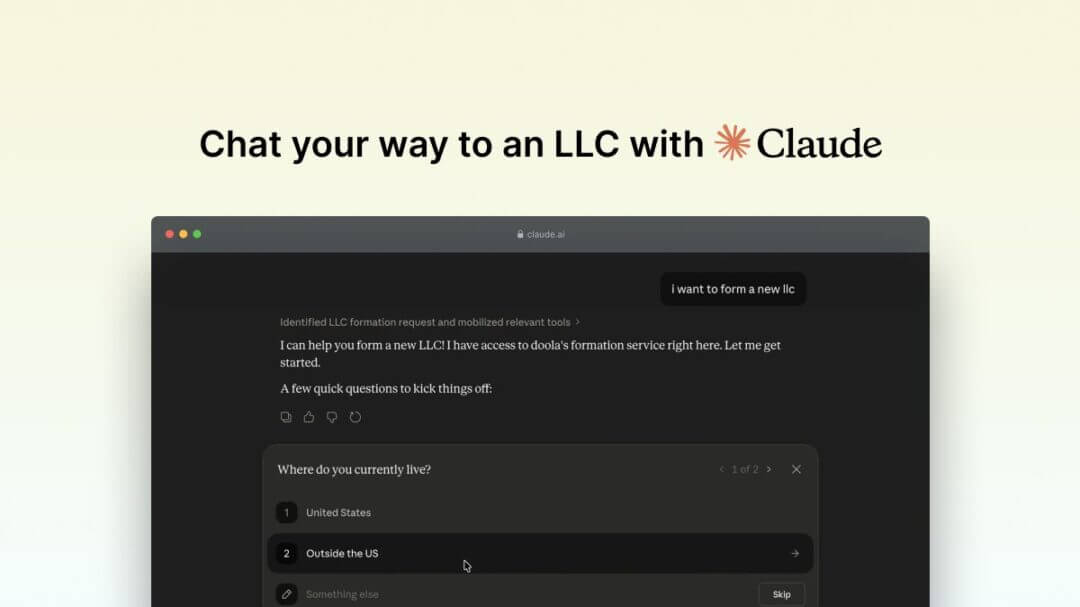
This video explains the complete setup.
Step by step
- Open Claude and go to Settings
- Navigate to Connectors → Add custom connectors
- Enter:
- Name: dollar
- MCP URL:
- Click Add and authorize the connection
- doola is now available in a new conversation
In Replit
This video explains the complete setup.
Step by step
- Open the Replit workspace
- Go to Settings → Integration → MCP Server for Replit Agent
- Add a new MCP server:
- Name: doola
- MCP URL:
- Connection authorization
- MCP doola is now available at Replit Agent
Form Your LLC Inside AI Chat
Once connected, you simply say:
“Help me form an LLC with doola.”
From there, an AI agent will guide you through the flow of the conversation. This experience is divided into two phases:
Before You Pay
The agent will gather the basics necessary to start your formation:
- Set up or log in to your account
- Select your company name and formation status (default: Wyoming)
- Choose your formation package and review prices
Once confirmed, you will complete the payment safely.
After Payment
After checkout, you return to the same conversation to complete your LLC setup:
- Confirm payment and continue your session
- Add a backup company name option
- Confirm business and mailing addresses
- Determine the IRS responsible party
- Determine the division of ownership between members
Final Step

Once everything is done:
- Your LLC is submitted for filing
- doola handles backend processing and registered agent coordination
- You get access to your doola dashboard to track formation status, download documents, and proceed with EIN, banking, and post-formation steps
What Makes This Possible
This is the first step towards a world where company creation is done with the same tools on which companies are actually built.
Rather than “stop building → form the company → come back,” founders now keep building; formation occurs alongside it.
PakarPBN
A Private Blog Network (PBN) is a collection of websites that are controlled by a single individual or organization and used primarily to build backlinks to a “money site” in order to influence its ranking in search engines such as Google. The core idea behind a PBN is based on the importance of backlinks in Google’s ranking algorithm. Since Google views backlinks as signals of authority and trust, some website owners attempt to artificially create these signals through a controlled network of sites.
In a typical PBN setup, the owner acquires expired or aged domains that already have existing authority, backlinks, and history. These domains are rebuilt with new content and hosted separately, often using different IP addresses, hosting providers, themes, and ownership details to make them appear unrelated. Within the content published on these sites, links are strategically placed that point to the main website the owner wants to rank higher. By doing this, the owner attempts to pass link equity (also known as “link juice”) from the PBN sites to the target website.
The purpose of a PBN is to give the impression that the target website is naturally earning links from multiple independent sources. If done effectively, this can temporarily improve keyword rankings, increase organic visibility, and drive more traffic from search results.


